
Halloween… the scariest day of the year.
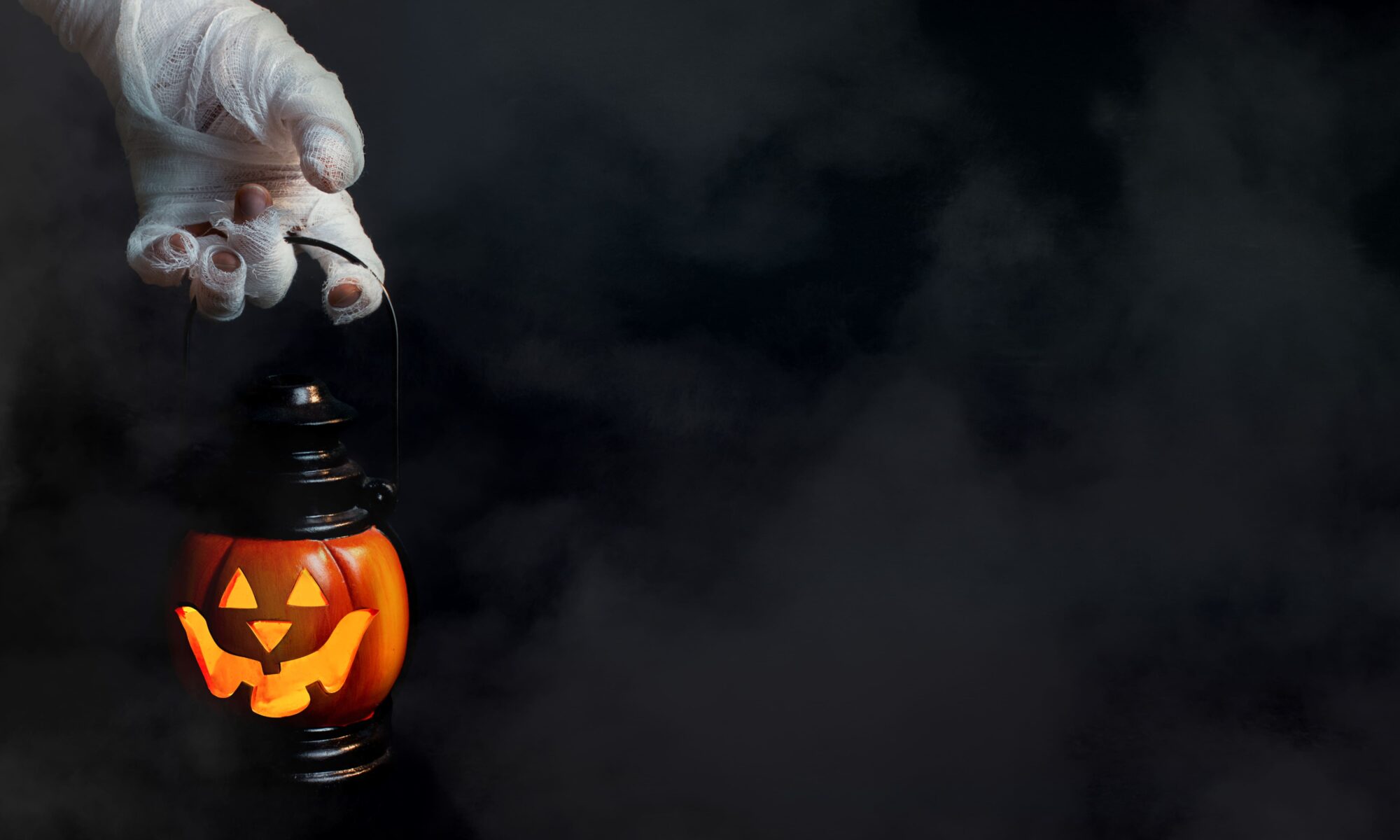
The day of spooky decorations and macabre, horrifying and sinister costumes.
The day when we have fun with the very things that usually frighten us.
Halloween intrigues me…
Why is it that on this day we seek out the very things we usually try to avoid?
The origins of Halloween and its connection to fear
Halloween, as we know it today, is the result of the transformation and transmission of pagan and Christian beliefs from different eras.
Although there is some debate, several historians point to the Celtic festival of Samhain as the origin of Halloween. The Celts believed that, at this time of year, the dead wandered between their world and that of the living.
Over the centuries, the end of October came to be marked by the return of the dead. Therefore, to ward off the spirits, people would blacken their faces with ash or wear masks. In this way, the living could recognise and interact with the deceased without attracting other dark forces.
As this ritual was passed down through the generations, by the 16th century people began going from door to door to collect ‘soul cakes’ in exchange for prayers. The aim of this practice was to free the souls from their torments so that they might rest in peace and not return to the world of the living.
What happens to us when we feel fear?
Psychology defines fear as an innate emotion involving a biochemical and emotional response designed to alert us to a dangerous situation (whether real or imagined).
Think about the last time you felt fear.
You may have felt your heart beating faster, your breathing becoming more rapid, and you may have started to sweat as if you’d just run a marathon.
Estas reações físicas têm como objetivo preparar-te para ficar imobilizado, confrontar ou fugir do perigo perante o medo.
However, not everyone experiences the same symptoms. The way we experience fear also varies from person to person. Our personality, life experiences and circumstances all influence how we react to a frightening situation.
The most intriguing thing about fear is that it shares the same physiological triggers as excitement. This means that the body can become highly aroused during both an exciting and an unpleasant experience. As people react differently to fear, research has sought to understand what leads some to seek out frightening experiences for fun, whilst others prefer to avoid them.
Why do we seek out frightening experiences?
Humans have always been curious about the unknown or about things they cannot understand. There are several explanations for this phenomenon. One of them is morbid curiosity.
According to the American psychologist Coltan Scrivner, morbid curiosity is a cognitive mechanism for learning about hypothetical threats, aimed at ensuring the survival of the human species. In other words, morbid curiosity enables us to gather information about what happens in life-threatening situations so that we can avoid them.
Halloween, horror films, true-crime documentaries and visits to haunted houses are all ways in which we harness morbid curiosity as a form of entertainment.
Fear in a safety context
In 2020, a group of researchers from Aarhus University in Denmark monitored a group of 110 people who visited a haunted house.
The results revealed an inverted U-shaped relationship between fear and enjoyment at certain points during the experience; in other words, enjoyment tended to be greatest when fear was moderate, decreasing when the intensity was too low or too high. This suggests that, under certain circumstances, a degree of fear can make an experience more exciting, whilst an excessive level can make it unpleasant.
The excitement, the anticipation and the surprise
These are the key ingredients of any good horror film.
In “The Silence of the Lambs”, what terrifies us most about the character of Hannibal Lecter is not what we know he does, but what we do not know. Our brains are constantly searching for clues to anticipate his behaviour and protect ourselves, whilst the narrative leaves us unsure exactly when or how the threat will materialise.
This uncertainty provides enough realism for our bodies to react, whilst we sit comfortably on the sofa in the living room. On the other hand, the shock and fear stem from the anticipation of knowing that something horrific could happen at any moment.
We know this is a good film (as well as the five Oscars it won), because by the end we can say so with a smile on our lips. We can even laugh at the jump we made when we were startled. Once the brain realises we are safe, it becomes possible to release all the built-up tension.
Why don’t everyone enjoy scary experiences?
Whether or not one enjoys scary experiences depends very much on one’s personality and individual background. Whilst some people derive pleasure from the adrenaline rush, others experience prolonged and all-too-real discomfort.
Psychological research has sought to understand why people either love or hate feeling fear purely for the sake of entertainment.
A literature review published in 2019 identified some trends: lower levels of certain dimensions of empathy and a lower propensity to feel fear were associated with greater enjoyment of horror films. However, these relationships are not the same for everyone, nor for all types of content.
Another trend identified was that more empathetic people and those who have experienced traumatic situations tend to shy away from potentially frightening situations. Furthermore, this literature review found, on average, a greater preference for and enjoyment of horror films amongst men and boys, whilst acknowledging that these are trends observed in the studies analysed, rather than universal differences.
Despite the significance of this study’s findings, it is important to note that enjoying the sensation of fear is not the same as enjoying the content that provokes fear. Whilst one person may appreciate the tension and surprise of a film without enjoying violent scenes, another may be curious about real-life crimes without enjoying the sensation of fear.
A sense of control can also influence how we experience a frightening situation. If we know that, despite the fear, we are in a controlled and temporary environment, the experience can become entertainment and fun.
Perhaps that is what makes fear on Halloween so unique: we do not necessarily seek out danger, but rather the thrill of approaching it whilst knowing we can return to safety. And, for some people, that combination is precisely what makes the experience fun.
References
Andersen, M. M., Schjoedt, U., Price, H., Rosas, F. E., Scrivner, C., & Clasen, M. (2020). Playing with fear: A field study in recreational horror. Psychological Science, 31(12), 1497–1510. https://doi.org/10.1177/0956797620972116
Coltan Scrivner, The psychology of morbid curiosity: Development and initial validation of the morbid curiosity scale, Personality and Individual Differences, Volume 183, 2021, 111139, ISSN 0191-8869, https://doi.org/10.1016/j.paid.2021.111139
Martin GN (2019) (Why) Do You Like Scary Movies? A Review of the Empirical Research on Psychological Responses to Horror Films. Front. Psychol. 10:2298. doi: https://doi.org/10.3389/fpsyg.2019.02298
Wiley, J. K., Rivers, A. A., Johnson, O. G., Negraru, C. S., Watson, J. T., Perreault, T. M., Martin, R., Slayton, S. C., Segovia-Palacios, S. I., Stanisky, B. R., Doherty, K. E., & Swan, L. K. (2026). Haunted attraction: The effects of recreational fear on interpersonal bonding. Emotion, 26(3), 519–532. https://doi.org/10.1037/emo0001615
The Celtic Origins of Trick-or-Treating (2024).https://www.smithsonianmag.com/history/celtic-origins-trick-treating-halloween-180984916/